
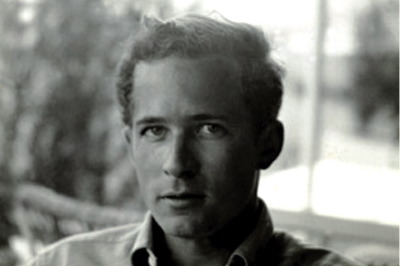
Filmmakers’ fascination with the sixties New York City art scene, particularly the elements of it that orbited around Andy Warhol, continues to yield more and more films, but Esther Robinson’s A Walk Into the Sea: Danny Williams and the Warhol Factory has a very unusual, very personal hook to it.
The ostensible subject, Danny Williams, was a somewhat minor figure in the scene (By most accounts; the influence individuals exerted and the credit they deserved is something parties are still jockeying for 40 years later, as the film demonstrates).
He met a spectacular, mysterious and romantic end, having simply disappeared one night, never to be heard from again (Death or suicide seems likely, but no body was ever found).
And he happens to be the director’s uncle.
Robinson never met her uncle, but certainly his disappearance must have informed elements of her family life, and been particularly fascinating to her, doubly so once she pursued filmmaking (But I’m just guessing, you’ll have to ask her yourself; she’ll be at the Wex to introduce the film herself).
In 1966, Williams returned to his mother’s home in Massachusetts after his time in NYC, studying filmmaking with Warhol’s patronage (and camera) and, if the consensus of Robinson’s sources is to be believed, having been Warhol’s lover. He took the car out for a bit, and never returned, though the car was found pulled over to a precipice overlooking the ocean.
Did Williams throw himself into the sea in a fit of melancholy over his break up with Warhol? Was he high and drugs and fell in? Did he go in for a swim and accidentally drown? Did he meet someone there, someone who killed him? Did he disappear and start a new life elsewhere without ever informing any friends or family? Or did he, as the title suggests, simply walk into the sea?
Robinson explores these questions, rounding up surviving scenesters—John Cale, Harold Stevenson, Danny Fields, Billy Name, Paul Morrissey, Chuck Wein, Brigid Berlin, Ron Nameth, Nat Finkelstein, Gerard Manlanga—for interviews. As they search their memories to remember Williams, a conflicting picture arises.
But in the process, each says as much about themselves as they do about Williams, and there’s a certain degree of sadness in seeing these senior citizens contrasted against their younger selves, as Robinson introduces each via black and white footage for them from their Factory days. Saddest of all are those that are somewhat addled, or still nursing grudges and heartbreak from so many decades ago. In some it seems petty, in others romantic, but whether it’s a positive or negative sadness, it’s still a sadness.
In their collective memory, Williams is more than a bit of an enigma, and a concrete portrait of him never quite emerges. The most revealing information comes not from his fellow Factory artists, but from Robinson’s own family—she spends a great deal of time with Williams’ mother, her grandmother—
and from a curator of the Andy Warhol Film Project, who found copies of what were thought to be Warhol films but turned out to have been made by Williams.
Robinson shows us one of these in its entirety, and later, somewhat slyly reveals that we’ve been looking at Williams’ work all along, as she begins the film and often slides into ethereal black and white work that was her uncle’s.
In the ever growing body of films about Factory scene—and just a few months ago the Wex had another film about it in Jack Smith and the Destruction of Atlantis—Walk Into the Sea is a stand out, a collaborative work two family members of different generations separated by time and, more likely than not, death.
A Walk Into the Sea: Danny Williams and the Warhol Factory screens tomorrow night, Thursday, October 11, at 7 p.m. It will be introduced by filmmaker Esther Robinson. For more info, click to wexarts.org.
Hey, incredibly nice web site. I actually came throughout this on Bing, and I’m happy I did. I will definately be coming back again here much more often. Wish I could add on the conversation and bring somewhat far more to your table, but am just absorbing as much information as I can at the second. Give thanks to You
When you get your personal ipad time, maybe you also desire to have your own iPad Case and iPad Accessories to better protect the iPad. When you arrive to our site, the 1st you must know is that you’ll be able to buy the best quality and most expensive iPad case, also your favorite iPad cases and iPad accessories. There are hundreds kinds of ipad case
Hey, identified your website by accident doing a research on Yahoo but I?ll definitely be coming back. ? How can I believe in God when only last week I acquired my tongue caught inside the roller of an electric typewriter?
I know this is seriously boring and you’re skipping on the next comment, but I just wanted to throw you a big many thanks – you cleared up some things for me!