
Tag Archives: philip seymour hoffman

Film Review: The Savages

It’s been almost a decade since writer/director Tamara Jenkins’s semi-autobiographical coming of age comedy The Slums of Beverly Hills, and yet there’s no signs of rust or dust on her latest, a semi-semi-autobiographical melancholic comedy about one of the least funny topics imaginable—putting your demented, dying parent in a nursing home and then watching them die.

In a somewhat surreal opening in the incredibly surreal Sun City, Arizona, a brightly colored paradise for the aged and elderly, we meet Lenny Savage (Philip Bosco), who is beginning to lose his mind. When his equally elderly and sick live-in girlfriend dies and her family claims her house, Lenny finds himself without a home.

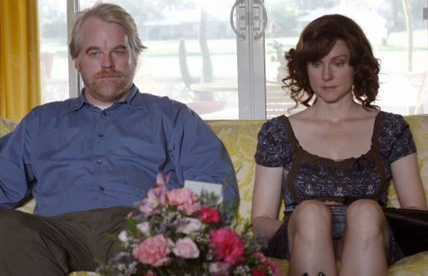
Enter his two adult children, Jon and Wendy Savage (played by Philip Seymour Hoffman and Laura Linney, respectively), whom Lenny abandoned as children and apparently abused to some unspecified degree. Both have grown accustomed to having nothing to do with their father and little to do with one another, but find themselves reunited and forced to care for him, despite having plenty of growing up to do themselves.
Jon is a Buffalo, New York based philosophy and theater professor working on a book about Bertolt Brecht and pushing away his Polish girlfriend, who has to leave the country when her visa expires unless he marries her, which is apparently out of the question.

Wendy is a temp in New York City applying for grants to produce her play about her messed-up childhood on company time, while carrying on a not-terribly-sexy romance with a fiftysomething married guy (Peter Friedman) who seems to be more devoted to his aging dog than he is to her.

Now, there are few things in the world more depressing than Buffalo, New York. And one of them is the umbrella category of nursing homes. So the young Savages moving their father into a nursing home in Buffalo in the winter? I had to just call a suicide hotline between typing that last sentence and starting this one; you can imagine how depressing seeing the actual film is.

Jenkins moderates the super-downer nature of the subject matter with plenty of humor, albeit of the extremely awkward kind, like her protagonists pissing off a whole dementia support group by touching their cookies before the meeting’s over, sponsoring a screening of 1927 Al Jolson talkie The Jazz Singer attended by plenty of black folks, or trying to get him on the record about what he’d like done with his body after he died.

Jenkins’ script is sharp, cutting just as deeply in its jokes as its drama, and as uncomfortable as it can be to watch at times, it’s extraordinarily well made, supported by three incredible performances. Bosco’s is of the sort that is likely to attract awards attention if enough people bother to see the film—he acts out a showy affliction, and he does so in a way that doesn’t look like he’s showing off. Hoffman does his normal strong job, mixing his schlubby art-housee Jack Black demeanor with the more serious, naturalistic tendencies. And Linney gives what may be the performance of her career, as a deeply flawed woman with a difficult relationship to the truth and the men in her life, a woman whose imperfections are at turns hilarious and heart-breaking, depending on the ever-shifting context.

That this is easily the year’s most observant and affective feature film about elder care should come as no surprise; that it’s one of the year’s more observant and effective feature films in general is, however.

Posted in Film | Tagged , | 6 Comments

Film Review: Charlie Wilson’s War

When we first meet Texas congressman Charlie Wilson, he’s naked in a Las Vegas hot tub full of coke-sniffing strippers and Playmates. But when he sees Dan Rather in a turban reporting from Afghanistan, he perks up and asks the bartender to turn up the TV.

That’s Wilson in a nutshell, a whiskey guzzling, tail-chasing believer in the good life, who just so happens to be extremely interested in the hottest front of the Cold War in the early ‘80s, Afghanistan, which the Soviet Union has just invaded (The Afghan people are, he notes, “the only people actually shooting at the Russians.”)

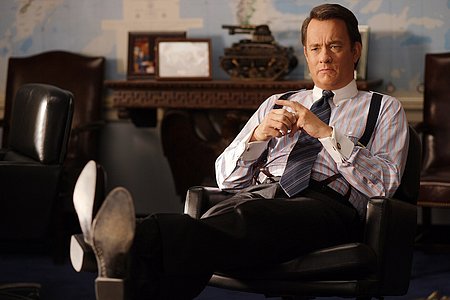
The two seemingly conflicting sides of the character amount to two character traits, and that’s about the extent to which director Mike Nichols, screenwriter Aaron Sorkin (working from the late George Crile’s non-fiction book of the same name), and Tom Hanks flesh Wilson out. Hanks’ co-stars similarly get two traits a piece.

Philip Seymour Hoffman (under tinted glasses, a moustache and funny hair) plays a CIA agent, who’s gruff and inelegant but earnest. A blonde Julia Roberts’s Texas fundraiser/activist is an ultra-right wing holy roller who shares Wilson’s love of a good time.

In a completely fictive movie, the characters might seem a little thin, but considering this is a true story—or at least “based on a true story”—then Nichols and company get a bit of a pass, as the truth can’t always be held to the same dramatic standards as feature film might (Particularly from me; I imagine a large swathe of the audience of this movie will remember some of these events as they were occurring, but I’m afraid my only interest in geopolitics in the early ‘80s was whether that ruthless terrorist organization determined to rule the world Cobra would ever defeat America’s daring highly-trained special mission force G.I. Joe).

It certainly helps how well Hanks—flexing his too often neglected comedic muscles—finds the country-fried charm in his character. His Wilson is in the right place and the right time, and possessing the right inclination, to get funding to the Afghans willing to fight the Russians. Roberts’ wealthy socialite identifies his keystone nature and seeks to exploit it, and they find a kindred spirit in Hoffman’s angry man agent.

Nichols spends most of his allotted time focusing on their initial battles to win funding to get weapons into the hands of their allies, and to do so in such a way that the U.S. will continue to be able to deny they’re helping shoot down Russian helicopters. From there, the film sort of montages through seven or eight years, spending more time on events than the people driving them.

But they are certainly exciting events, and it’s rather refreshing to return to the more black and white, Cold War hero/villain film paradigm, in which the Russians are the unequivocal bad guys. They just make for a much easier enemy to root against than the nebulous, country-less terrorists that play America’s enemies in most movies these days, you know?

Sorkin and Nichols frame Wilson as an ultimate American hero—a man of many character flaws but also admirable courage and noble virtue who manages to do great things. There are fist-pumping victories in the film to be sure, but Nichols keeps it far from feel-good territory, as both Hanks’ and Hoffman’s characters seem cognizant of where things can go from there, and their victory is presented as an unpredictable domino. The Russian defeat in Afghanistan went a way towards winning the Cold War, sure. But did it also lead to the takeover of the country by the Taliban? To 9/11? To the Iraq War?

As the quote coda from the real Wilson points out, the story is essentially one of a great victory with an element of tragedy. In other words, it’s a typically American story, for better and for worse, and the film is a clear-eyed presentation of it.

YouTube Preview Image
Posted in Music | Tagged , , , | 9 Comments